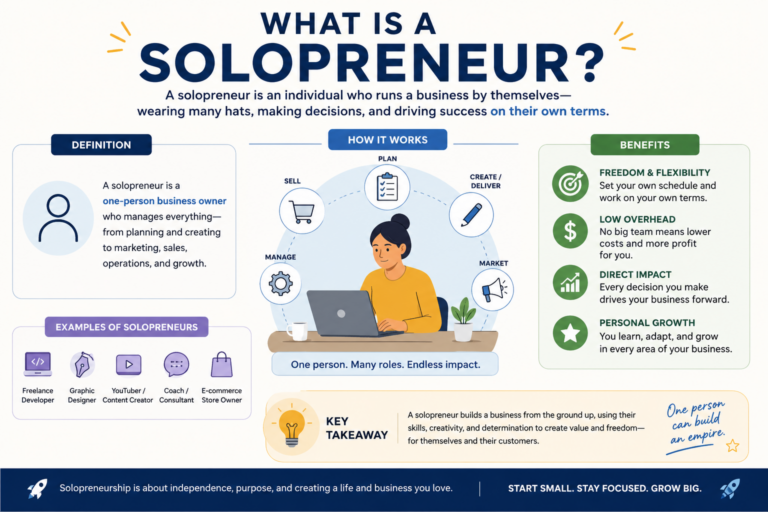
How to Build a One-Person Business as a Solopreneur in 2026 (Real Talk, No Hype)
Most people think that to build a “real” business you need: an office, employees, investors, or at least a business partner.
I believed that for the first 10 years of my career.
Then AI showed up — and I realized something almost embarrassingly simple: one solopreneur can do the work of an entire small team, if they know how to use AI in the right places.
Not because AI does everything for you. But because AI helps you move faster, work smarter, and skip years of painful trial and error on things that used to take a long time to learn.
In this post I’m going to be direct: here’s how to actually build a one-person business in 2026 — practically, without the hype, without pretending it’s easier than it is.
First: As a Solopreneur, You Still Have to Do Everything a Business Requires
Let me say this upfront.
AI doesn’t eliminate what a one-person business needs. As a solopreneur, you still have to:
- Generate traffic (get people to know you exist)
- Create content to keep them around
- Have a product or service to sell
- Know exactly who your customer is
- Build an offer compelling enough that they pull out their wallet
- Have a landing page that converts
- Write copy persuasive enough that people actually click buy
That sounds like a lot. And it is — which is exactly why so few solopreneurs actually pull it off.
But here’s what’s changed: learning each of those things used to take years. With AI, a one-person business owner can compress that timeline down to weeks — if you use it the right way.
I’m emphasizing “the right way” because most people are using AI wrong. They use it to do everything for them, then watch it produce a pile of stuff that looks impressive but makes zero money. I’ll come back to this trap later.
A Realistic Goal: How Much Can a Solopreneur Actually Make?
To make this concrete, let’s pick a real number. Say you want to hit $4,000/month from your one-person business — a level many solopreneurs consider “comfortably sustainable.”
You can get there multiple ways:
- Digital products (courses, templates, ebooks): sell 20–30 units/day at a modest price point
- Subscription / community: ~200–300 members paying monthly
- Freelance / services: 5–10 clients at $400–$1,000/month each
- Coaching / consulting: 1–2 clients at $1,500–$3,000/month
- Mixed model: a few clients + steady product sales every day
These aren’t fantasy numbers. Solopreneurs are doing it right now. The question is which path fits you.
Which Path Is Right for Your One-Person Business?
If you don’t have an audience yet: start with services.
This is something I learned from watching too many solopreneurs fail by starting in the wrong place.
If nobody knows who you are yet — don’t start by launching a course or digital product. You’ll build something, nobody will buy it, and you’ll think you failed.
Instead, start with a service. It’s much easier to sell a $500–$1,000 service to one specific person than to convince 100 strangers to buy a $50 product.
Services have another advantage: you learn fast. Working directly with clients gives you a front-row seat to what people actually need, how they talk about their problems, and where they’re stuck — that’s the most valuable raw material you’ll ever have for content and products later.
If you already have an audience: now’s the time to build a product.
Once you have people who follow and trust you, selling digital products becomes much easier because the traffic is already there. This is where a solopreneur business really starts to scale without adding headcount.
But to build traffic, you need content. And for content to work, you need a personal brand.
The 3 Pillars of a Successful Solopreneur Business
No need to overcomplicate it. A functional one-person business needs exactly three things:
1. Personal Brand — Who knows you, and why they care
This isn’t about colors or a nice logo. Your personal brand as a solopreneur is the answer to two questions:
- Who do you help, and with what?
- Why should someone trust you over anyone else?
I always say: you are your own niche. You don’t pick a niche and jump in. You look honestly at yourself — your experience, your skills, what you care about — and find where those things intersect.
For me, that intersection is: 15 years as a developer, 3 years using AI daily, wanting to help business owners use AI without needing to know how to code. That’s a position nobody else is standing in — in my space, in my language.
You have a position like that too. You just need to find it.
2. Content — What pulls strangers to your one-person business every day
Content is a solopreneur’s most powerful asset — an automated customer acquisition machine that runs free, 24/7, even while you sleep.
But most solopreneurs write content the wrong way. They write about features instead of benefits. They talk about the tool instead of the problem the tool solves.
My rule: always start from the reader’s problem, never from what you want to say.
❌ “AI can automate your workflow” ✅ “I used to spend 3 hours a day replying to customer messages. Now it takes 15 minutes.”
The first sentence talks about a tool. The second talks about the outcome people actually want.
My current content system as a solopreneur is simple:
- One long post on my blog each week (like this one)
- That becomes 3–5 shorter posts on social media
- The best moments become short-form video
- Whatever performs best gets turned into a carousel
Create once, distribute everywhere. No need to invent new ideas every single day.
3. Offer — What your one-person business actually sells
This is the part most solopreneurs dread most.
But your offer doesn’t need to be complicated. In the early stages, the simplest solopreneur offer is: I do X for you, you pay me Y.
Once you understand what customers really need — from working with them directly — you’ll know how to package something they actually want to buy.
How Solopreneurs Should Use AI (And How Most Get It Wrong)
This is my favorite part, because it’s what I do every day running my one-person business.
Where AI genuinely helps solopreneurs:
- Fast research: instead of reading 5 books on copywriting, you can load that knowledge into AI and have a conversation with it
- Faster ideation: from one topic, AI can suggest 20 different angles in 30 seconds
- First drafts: not to publish as-is, but to give you raw material to edit and shape
- Visuals, video, voiceover: things that used to require hiring someone, a solopreneur can now handle alone
But — and this is the most important part —
AI cannot replace your understanding of your own customers.
AI doesn’t know when your customers tend to send messages. AI doesn’t know the exact words your specific audience uses when they search for what they need. AI doesn’t know the specific pain points of the people in your niche.
You know that. That’s your edge as a solopreneur.
The Trap Most Solopreneurs Fall Into
I see this constantly — and honestly, I’ve fallen into it myself:
People use AI to make plans. Then more plans. Then ask AI what to do next. Then watch AI build something that looks impressive. Then feel like they’re “working” when really they’re just watching AI work.
End of the month — nothing to show. No clients. No content published. No money in.
Using AI to execute faster: correct. Using AI to replace thinking and decision-making in your one-person business: wrong.
The solopreneur running the AI still needs to know what they’re doing, why they’re doing it, and what good results look like. If you don’t know that, AI won’t figure it out for you — it’ll just produce things that look fine on the surface but are hollow underneath.
So, Where Does a Solopreneur Start?
Here’s the path I’m walking myself:
Week 1: Get clear on who you help and with what. Doesn’t need to be perfect — just specific enough to start having real conversations with real people.
Weeks 2–4: Reach out to 10–20 potential customers. Don’t sell anything — just ask what problems they’re dealing with. Listen. Take notes.
Month 2: Start posting content based on what you learned from those conversations. Post consistently, post authentically, post about problems people actually care about.
Month 3: Launch your first offer — a simple service, fair price, aimed at the people you’ve already talked to.
After 90 days: Look back, adjust, keep going.
Not perfect, full of uncertainty — but you’ll learn more in those 90 days than most solopreneurs learn in 2 years of planning.
One Last Thing
The barrier to starting a one-person business has never been lower. But that also means more solopreneurs than ever will try — and quit.
The winner isn’t the solopreneur who uses AI the most. The winner is the person who keeps going, keeps improving, and doesn’t stop when AI doesn’t do everything for them.
You still have to learn. You still have to practice. And you have to be willing to fail a few times before it works.
AI just helps you move faster on that road — it doesn’t walk it for you.ster, work smarter, and skip years of painful trial and error on things that used to take a long time to learn.
In this post I’m going to be direct: here’s how to actually build a one-person business in 2026 — practically, without the hype, without pretending it’s easier than it is.
First: You Still Have to Do Everything a Business Requires
Let me say this upfront.
AI doesn’t eliminate what a business needs. You still have to:
- Generate traffic (get people to know you exist)
- Create content to keep them around
- Have a product or service to sell
- Know exactly who your customer is
- Build an offer compelling enough that they pull out their wallet
- Have a landing page that converts
- Write copy persuasive enough that people actually click buy
That sounds like a lot. And it is — which is exactly why so few people actually pull it off.
But here’s what’s changed: learning each of those things used to take years. With AI, you can compress that timeline down to weeks — if you use it the right way.
I’m emphasizing “the right way” because most people are using AI wrong. They use it to do everything for them, then watch it produce a pile of stuff that looks impressive but makes zero money. I’ll come back to this trap later.
A Realistic Goal: How Much Do You Actually Need to Make?
To make this concrete, let’s pick a real number. Say you want to hit $4,000/month from a one-person business — a level many solopreneurs consider “comfortably sustainable.”
You can get there multiple ways:
- Digital products (courses, templates, ebooks): sell 20–30 units/day at a modest price point
- Subscription / community: ~200–300 members paying monthly
- Freelance / services: 5–10 clients at $400–$1,000/month each
- Coaching / consulting: 1–2 clients at $1,500–$3,000/month
- Mixed model: a few clients + steady product sales every day
These aren’t fantasy numbers. People are doing it. The question is which path fits you.
Which Path Is Right for You?
If you don’t have an audience yet: start with services.
This is something I learned from watching too many people fail by starting in the wrong place.
If nobody knows who you are yet — don’t start by launching a course or digital product. You’ll build something, nobody will buy it, and you’ll think you failed.
Instead, start with a service. It’s much easier to sell a $500–$1,000 service to one specific person than to convince 100 strangers to buy a $50 product.
Services have another advantage: you learn fast. Working directly with clients gives you a front-row seat to what people actually need, how they talk about their problems, and where they’re stuck — that’s the most valuable raw material you’ll ever have for content and products later.
If you already have an audience: now’s the time to build a product.
Once you have people who follow and trust you, selling digital products (courses, templates, communities) becomes much easier because the traffic is already there.
But to build traffic, you need content. And for content to work, you need a personal brand.
The 3 Pillars of a One-Person Business
No need to overcomplicate it. A functional one-person business needs exactly three things:
1. Personal Brand — Who knows you, and why they care
This isn’t about colors or a nice logo. Your personal brand is the answer to two questions:
- Who do you help, and with what?
- Why should someone trust you over anyone else?
I always say: you are your own niche. You don’t pick a niche and jump in. You look honestly at yourself — your experience, your skills, what you care about — and find where those things intersect.
For me, that intersection is: 15 years as a developer, 3 years using AI daily, wanting to help business owners use AI without needing to know how to code. That’s a position nobody else is standing in — in my space, in my language.
You have a position like that too. You just need to find it.
2. Content — What pulls strangers to you every day
Content is your automated customer acquisition machine — free, running 24/7, even while you sleep.
But most people write content the wrong way. They write about features instead of benefits. They talk about the tool instead of the problem the tool solves.
My rule: always start from the reader’s problem, never from what you want to say.
❌ “AI can automate your workflow” ✅ “I used to spend 3 hours a day replying to customer messages. Now it takes 15 minutes.”
The first sentence talks about a tool. The second talks about the outcome people actually want.
My current content system is simple:
- One long post on my blog each week (like this one)
- That becomes 3–5 shorter posts on social media
- The best moments become short-form video
- Whatever performs best gets turned into a carousel
Create once, distribute everywhere. No need to invent new ideas every single day.
3. Offer — What you actually sell
This is the part most people dread most.
But your offer doesn’t need to be complicated. In the early stages, the simplest offer is: I do X for you, you pay me Y.
Once you understand what customers really need — from working with them directly — you’ll know how to package something they actually want to buy.
How to Use AI Correctly Throughout This Process
This is my favorite part, because it’s what I do every day.
Where AI genuinely helps:
- Fast research: instead of reading 5 books on copywriting, you can load that knowledge into AI and have a conversation with it
- Faster ideation: from one topic, AI can suggest 20 different angles in 30 seconds
- First drafts: not to publish as-is, but to give you raw material to edit and shape
- Visuals, video, voiceover: things that used to require hiring someone, you can now do yourself
But — and this is the most important part —
AI cannot replace your understanding of your own customers.
AI doesn’t know when your customers tend to send messages. AI doesn’t know the exact words your specific audience uses when they search for what they need. AI doesn’t know the specific struggles of a small business owner in your city, in your industry.
You know that. That’s your edge.
The Trap Most People Fall Into
I see this constantly — and honestly, I’ve fallen into it myself:
People use AI to make plans. Then more plans. Then ask AI what to do next. Then watch AI build something that looks impressive. Then feel like they’re “working” when really they’re just watching AI work.
End of the month — nothing to show. No clients. No content published. No money in.
Using AI to execute faster: correct. Using AI to replace thinking and decision-making: wrong.
The person running the AI still needs to know what they’re doing, why they’re doing it, and what good results look like. If you don’t know that, AI won’t figure it out for you — it’ll just produce things that look fine on the surface but are hollow underneath.
So, Where Do You Start?
Here’s the path I’m walking myself:
Week 1: Get clear on who you help and with what. Doesn’t need to be perfect — just specific enough to start having real conversations with real people.
Weeks 2–4: Reach out to 10–20 potential customers. Don’t sell anything — just ask what problems they’re dealing with. Listen. Take notes.
Month 2: Start posting content based on what you learned from those conversations. Post consistently, post authentically, post about problems people actually care about.
Month 3: Launch your first offer — a simple service, fair price, aimed at the people you’ve already talked to.
After 90 days: Look back, adjust, keep going.
Not perfect, full of uncertainty — but you’ll learn more in those 90 days than most people learn in 2 years of planning.
One Last Thing
The barrier to starting has never been lower. But that also means more people than ever will try — and quit.
The winner isn’t the person who uses AI the most. The winner is the person who keeps going, keeps improving, and doesn’t stop when AI doesn’t do everything for them.
You still have to learn. You still have to practice. And you have to be willing to fail a few times before it works.
AI just helps you move faster on that road — it doesn’t walk it for you.
I’m Chinh — 15-year developer, running a one-person business with AI and sharing what actually works. If this was useful, subscribe for more.