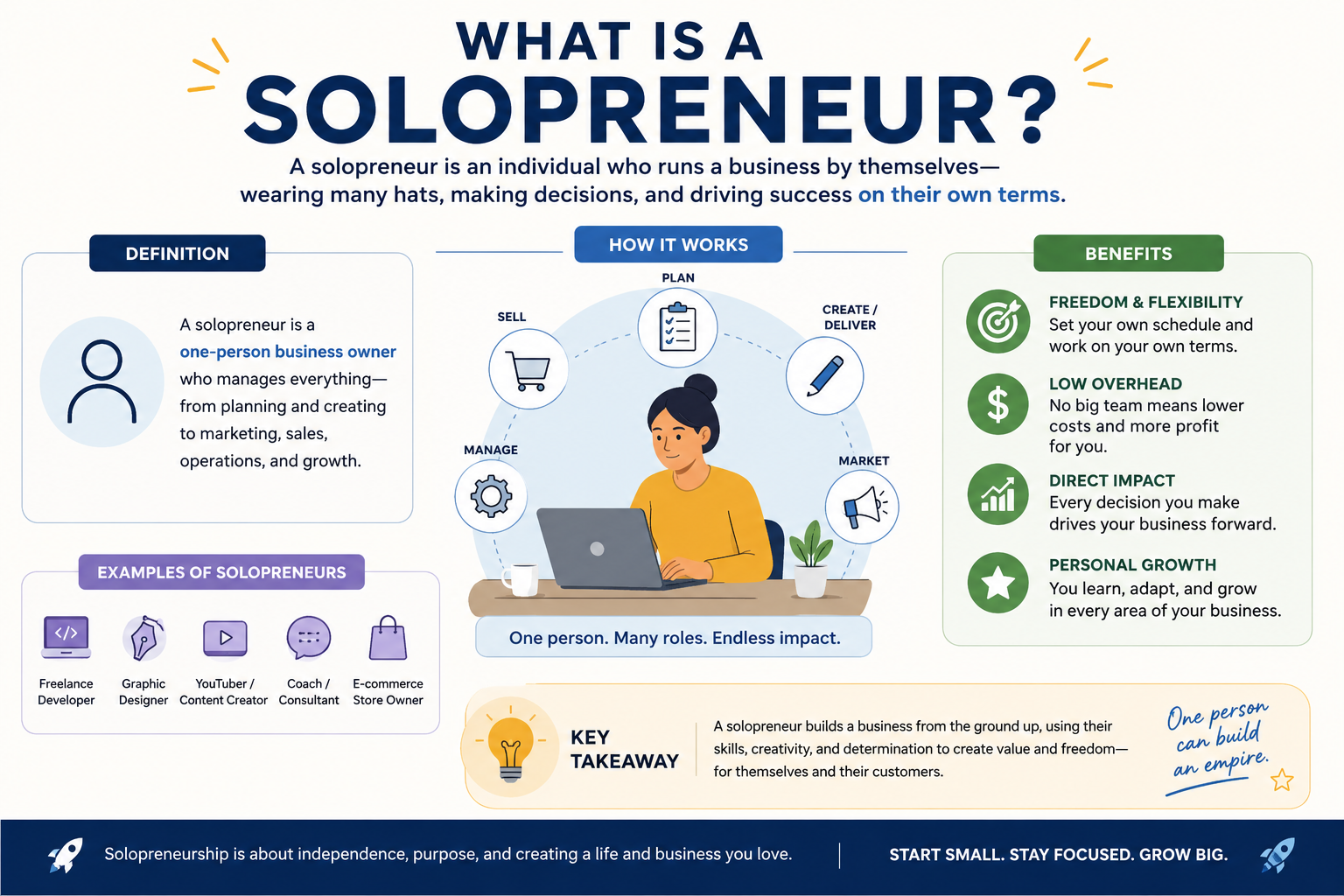
What Is a Solopreneur? The Complete Guide to Running a One-Person Business
You’re handling everything on your own — sales, customer service, bookkeeping, content, fulfillment — and somewhere along the way you’ve wondered: “Is there even a word for what I’m doing?”
There is: solopreneur.
And if you’re reading this, chances are you’re already one — you just didn’t know the name.
What Is a Solopreneur?
A solopreneur (also called a one-person business) is someone who builds and runs a business entirely on their own — no co-founder, no full-time employees, and no ambition to scale into a large company.
The goal of a solopreneur is simpler and more personal: generate enough revenue to live life on your own terms, do work you’re actually good at, and answer to nobody.
How Is a Solopreneur Different from a Freelancer?
A freelancer sells time. They take a project, do the work, get paid, then find the next project. A freelancer’s income is capped by the number of hours they can work in a day.
A solopreneur builds systems. They create products, content, or processes that generate revenue even when they’re not actively working. A solopreneur’s income isn’t limited by time — it’s limited by how many people they can reach.
Real-world example:
- Freelance designer: takes an order, makes a logo, delivers it, gets paid
- Solopreneur designer: sells Canva templates, writes a design blog, teaches an online course — revenue running 24/7
What Does a One-Person Business Actually Look Like?
Solopreneurs come in many forms. Some of the most common:
Solo e-commerce operator — running an entire online store from sourcing to shipping, alone. Many one-person businesses in this space are quietly doing serious revenue with zero employees.
Content creator who sells — a niche account or small creator who combines affiliate links, brand deals, and their own products.
Specialist service provider — designer, copywriter, video editor, or consultant working directly with clients, no agency in between.
Online teacher or mentor — teaching skills through live sessions or selling pre-recorded courses.
Developer or technical freelancer — building tools, websites, or automations for multiple clients simultaneously.
The common thread: one person, many roles, no office required.
Why the One-Person Business Model Is Exploding Right Now
1. Startup costs are essentially zero
In 2026, you need: a laptop (you have one), a phone (you have one), internet (you have it). Your first month’s overhead can be close to nothing if you start with a service.
2. Social media gives solopreneurs unlimited reach
A one-person business can sell to customers across the country — or across the world — without a physical location or a sales team.
3. AI has erased the advantage that large teams used to have
Before: great product photos required hiring a photographer. Video required an editor. Content required a copywriter.
Now, a solopreneur who knows how to use AI can handle all of that — not as fast as a full professional team, but good enough to make real money.
What Skills Does a Solopreneur Actually Need?
1. Create real value (Core Skill)
This is what you sell. If you’re not sure what your core skill is, answer this question: “What do people come to me for help with?”
2. Attract customers (Marketing)
You can be the best at what you do — but if nobody knows you exist, it doesn’t matter. For solopreneurs, the most effective and affordable marketing channel is content. Pick one platform, do it well first.
3. Persuade people to buy (Sales & Copywriting)
Sales is simply explaining clearly why what you offer solves the buyer’s problem. This shows up everywhere in a one-person business: your post headlines, your product descriptions, how you reply to customer messages.
4. Run without bottlenecks (Systems)
Build repeatable processes — checklists, templates, automations — so you’re not reinventing the wheel every time you do the same task.
The Real Challenges of Running a One-Person Business
Nobody assigns you work. That sounds freeing, until you realize many people struggle to create structure for themselves without external accountability.
Income is unpredictable, especially early on. Have at least 3–6 months of living expenses saved before going fully solo.
It can get lonely. No team, no colleagues. Many solopreneurs underestimate this one.
The “busy but not growing” trap. You can stay constantly busy — replying to messages, processing orders — while your business stays exactly the same size, because you’re not investing time in the work that actually moves things forward.
How to Start as a Solopreneur
Step 1: Identify what you’re good at and who needs it.
Step 2: Find 3 people to talk to — not to sell to, just to understand what problems they’re dealing with.
Step 3: Create the simplest possible offer: “I do X for you, you pay me Y.”
Step 4: Start creating content around the problem you help people solve.
Step 5: Repeat and improve.
The Bottom Line
The solopreneur — the one-person business — isn’t a new idea. But in 2026, with AI and social media as force multipliers, it’s the most accessible business model that has ever existed.
You don’t need a team. You don’t need significant capital. You don’t need a degree.
What you do need: a real skill, a genuine understanding of your customer, and the persistence to keep going before things start working.
I’m Chinh — 15-year developer, running a one-person business with AI and sharing what actually works for solopreneurs. Subscribe for more.