How to use AI to become smarter
Most people are using AI to become lazier. Not smarter — lazier.
They let AI write for them, think for them, decide for them. Then six months later they look back and realize they can’t do anything without it anymore. Not because AI got too good — but because they stopped training.
This is a framework from theMITmonk that I think gets it most right — not about using AI to go faster (though it does that too), but about actually getting smarter over time.
Four steps. Each one a different way of looking at your relationship with AI.
Step 1: Intelligent Laziness — Be lazy in the right places
A Harvard Business Review study found that CEOs waste 72% of their time in meetings that produce no decisions. I’m not surprised. I’ve sat in those meetings — or the solopreneur equivalent: replying to emails, reformatting slides, tweaking a Google Doc layout, rewriting a caption to get the tone “just right.”
The brain has a bug called completion bias — it loves the feeling of finishing something, regardless of how important that thing was. The dopamine hit you get from checking off an internal email is roughly the same as the one you get from completing a 3-month business strategy, even though the value of those two tasks is worlds apart. So you end up treating everything the same — and the day ends with a lot of checkboxes ticked and not much that actually mattered.
To escape this trap, look at your work through two curves.
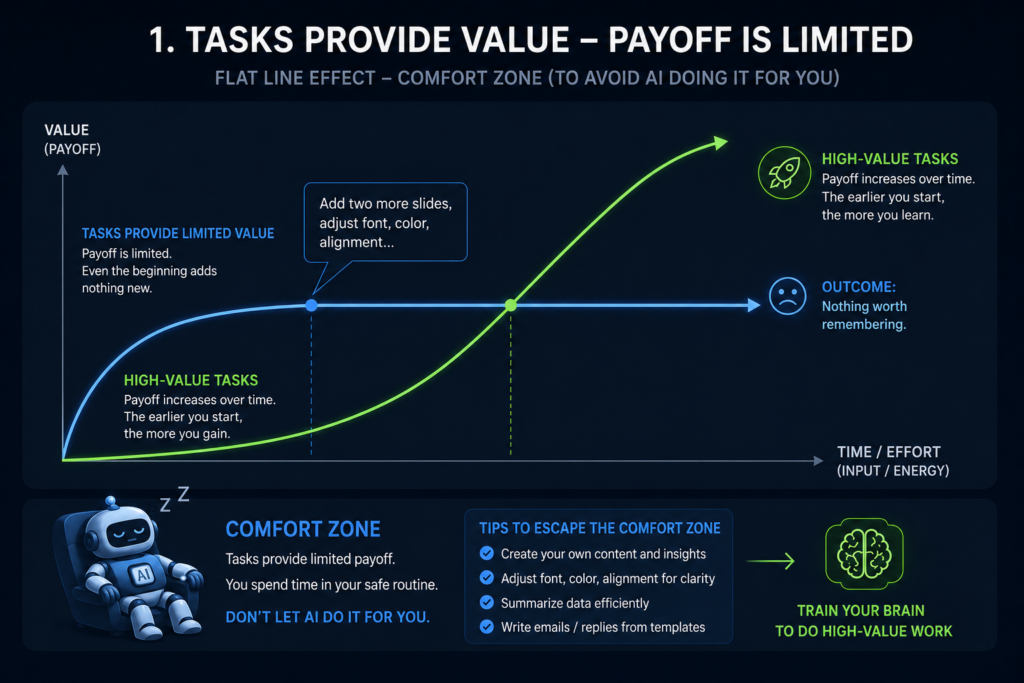
The first curve is low-value tasks with capped payoffs. You could spend two more hours on that internal slide — better fonts, better colors. Would anyone notice? No. The value flatlines after a point. This is your zone of laziness, and it’s exactly where you should hand things off to AI.
The second curve is the important stuff with uncapped payoffs. Key client interactions, product design, pricing strategy, deciding which direction to move next. Here, being 1% better doesn’t give you 1% better results — it can solve the other 99% of your problems. This is your zone of obsession. Do it yourself, and every hour you put in is worth it.
So how do you know which zone a task belongs to? theMITmonk uses a framework called DRAG to identify what to delegate:
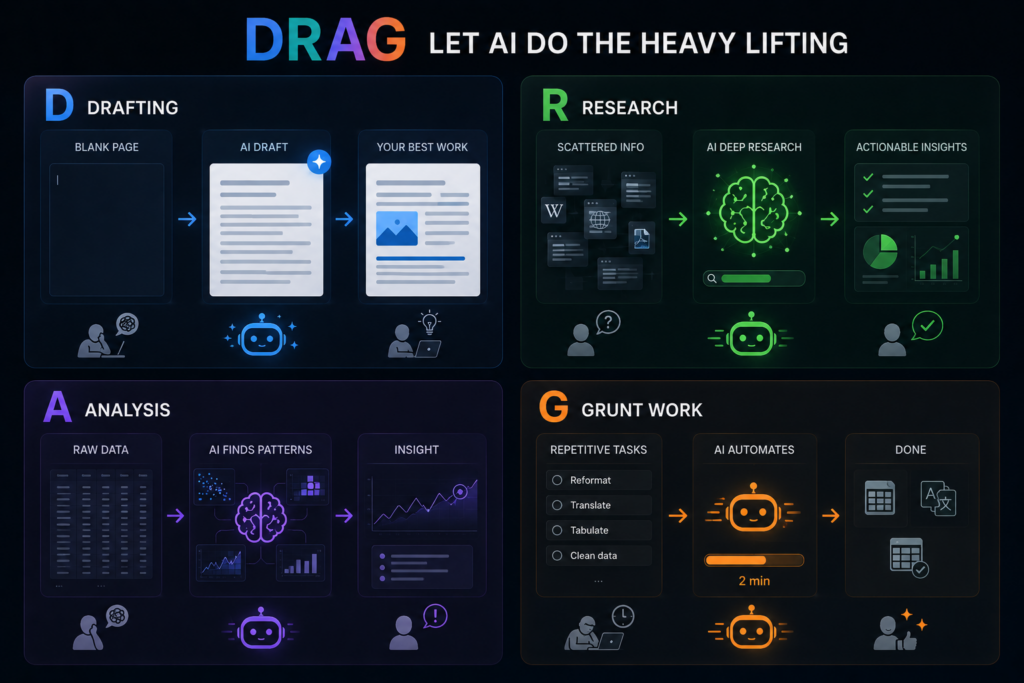
D — Drafting. The hard part isn’t writing — it’s staring at a blank page with no idea where to start. AI gets you past that. The first draft will be terrible. That’s fine. You have a starting point to work from, and that’s all you need.
R — Research. When you run deep research on Claude or ChatGPT, it fires off hundreds of queries, reads hundreds of pages, synthesizes the results, then asks itself “what’s missing?” and keeps going. What you get in 10 minutes equals a week of junior consultant research. Use it.
A — Analysis. Analyzing raw data, unstructured data, finding patterns — AI catches things the human brain can’t, especially at scale. I regularly paste three months of customer data into Claude and ask what it sees. It finds things I missed the entire time.
G — Grunt work. All the repetitive stuff: reformatting, translating, tabulating, cleaning data. Half a day by hand. Two minutes with AI.
The rule with DRAG: apply it when you’re on the first curve. If a task requires judgment, intuition, decision-making, or real human interaction — that’s the second curve. Do it yourself, and don’t shortcut it.
About 70-80% of my repetitive work sits in zone one. Yours probably does too.
Step 2: Intelligent Hill — Climb it properly
AI is not a calculator.
A calculator is certain: 2 + 2 = 4, always. AI is a probability engine — ask it the same question twice and you might get two different answers. It’s completely confident even when it’s wrong. It won’t admit it doesn’t know something — it’ll make something up that sounds entirely plausible.
Once you understand this, it changes how you prompt entirely.
Most people use zero-shot prompting — ask directly, no context. “Give me a good business idea.” AI hands you a long list, with total confidence, and it’s completely generic. Not because AI is bad — because you’re rolling the dice.
To get better results, you need to climb the Intelligent Hill. There are four camps on the way up:
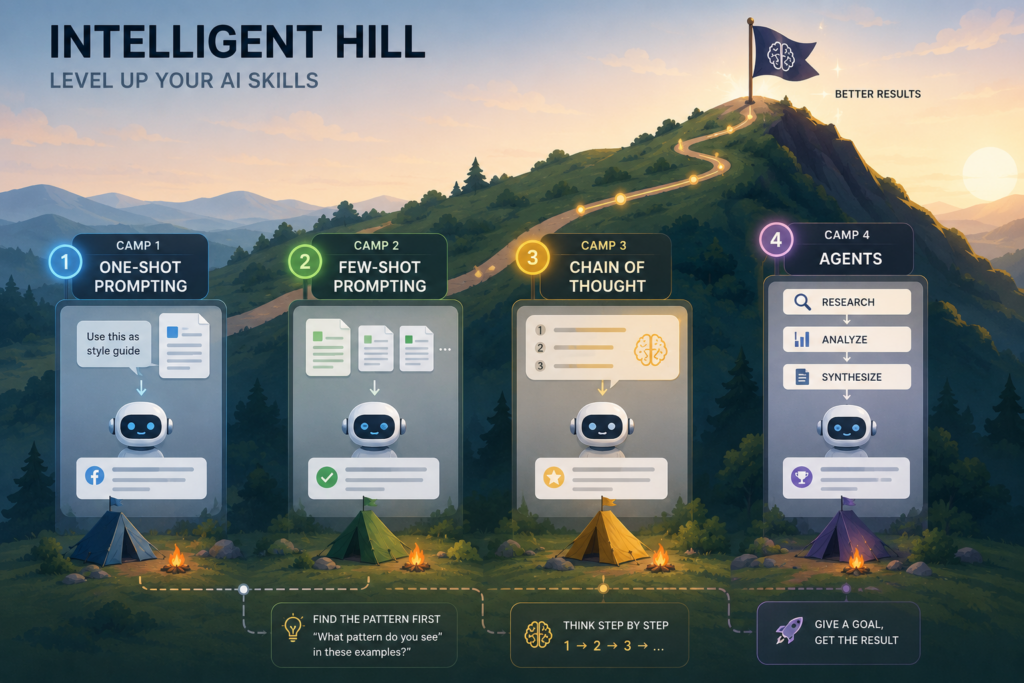
Camp 1 — One-shot prompting. Give AI one concrete example before you ask. Instead of “write me a LinkedIn post about remote work,” you say “write a LinkedIn post about remote work, using this post as a style guide” and paste in the example. One specific reference already beats rolling the dice.
Camp 2 — Few-shot prompting. Give AI 3-5 examples so it can find patterns in the tone, style, and substance you want. Paste in your old posts, past presentations, emails that worked. This is called grounding the model — it stops hallucinating and connects to your reality.
A useful trick: ask AI “what patterns do you notice in these examples?” before asking it to create anything new. That forces AI to articulate what it’s doing — and forces you to think about how you actually write. You’re getting smarter about yourself.
Camp 3 — Chain of thought. Ask AI to think step by step before responding. Instead of “improve this research,” try: “Don’t change anything yet. Analyze this and list the three most important areas for improvement, explain why each matters, and suggest how to address them. Think step by step. Show me your reasoning.” That last line is the most important. It cuts hallucinations, improves quality, and lets you see how AI is actually thinking.
Camp 4 — Agents. Instead of asking one question at a time, hand off an entire workflow. “Research trends in industry X. Analyze and identify the three most significant ones. Write a one-page summary with specific action items.” AI handles the research, analysis, and synthesis. You get the finished output.
Practical approach: take any prompt you’re about to use and try climbing one camp higher than you normally would. You don’t need to jump from zero-shot to agents overnight. One step at a time.
Step 3: Intelligent Gym — Don’t let your brain atrophy
This is the part I want to talk about most, because it’s the part almost everyone skips.
The first two steps make you faster and more efficient. And that’s exactly when things get dangerous.
Because when everything gets easier, you stop training. And muscles — including the mental kind — atrophy when you stop using them.
Astronauts in zero gravity for months lose up to 20% of their muscle and bone mass. AI is zero gravity for your thinking. No friction, no load, no growth.
The principle is simple: for information tasks, use AI to remove friction. For transformation tasks, use AI to add friction.
The difference: an information task is when you need to know something in order to move forward. A transformation task is when you need to deeply understand something — well enough to reason through it, synthesize it, and level up as a person.
In a physical gym, a spotter doesn’t lift the weight for you. They stand next to you, make sure you don’t get crushed, and help you push out one more rep when you think you’re done. AI is your spotter — not the person doing the workout for you.
Here’s the concrete approach: when you want to learn a concept, read it first, sit with it. Then bring it to AI and say: “I need to fully master this concept. Quiz me with progressive overload across four levels.”
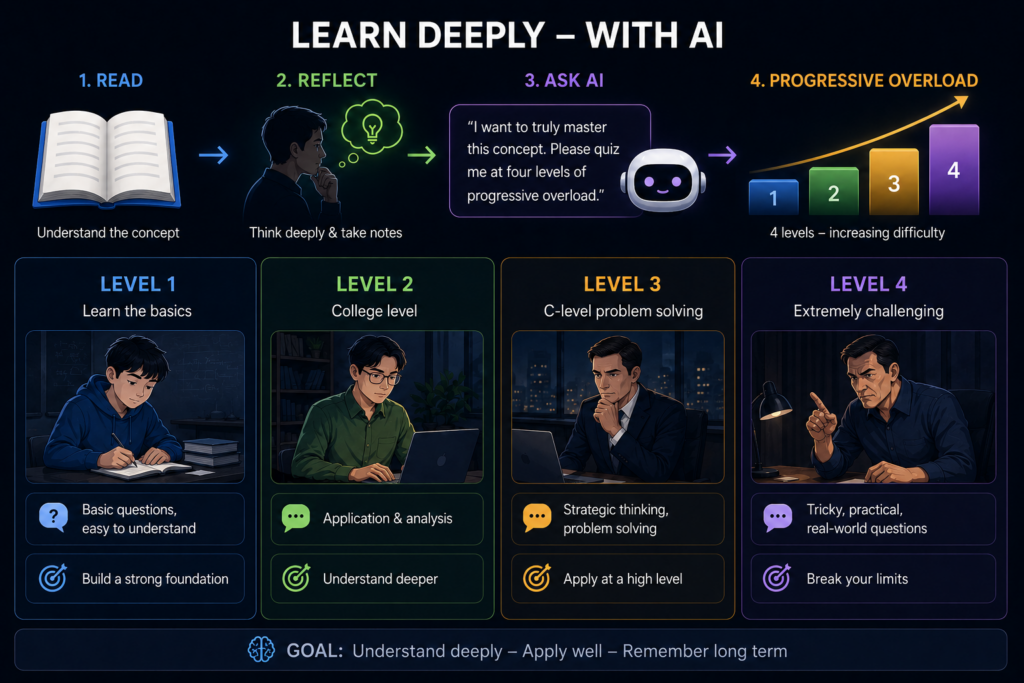
Level 1: Quiz me like I’m a high school student.
Level 2: Question me like I’m a college student.
Level 3: Grill me like you’re interviewing me for a C-level role.
Level 4: Challenge me like a demanding boss who thinks I’m underprepared.
When you get grilled at levels 3 and 4, you’ll discover the real gaps in your understanding — not the ones you thought you had, but the ones you didn’t know existed. That’s actual learning.
This is what I do now across a lot of areas — marketing, copywriting, business concepts I never formally studied. Instead of letting AI talk at me, I let AI question me. Then I have to answer.
Step 4: Intelligent Fool — Check your ego at the door
In 2014, when Satya Nadella became CEO of Microsoft, the company was struggling. They’d missed search, missed mobile, and were losing the cloud race to Amazon. But the bigger problem was the culture inside: people were afraid to admit they didn’t know something, afraid to say “I was wrong,” because that meant weakness.
Satya made one move: he declared the company was shifting from a culture of know-it-alls to a culture of learn-it-alls.
A decade later, Microsoft’s market cap went from $300 billion to over $3 trillion. 10x in 10 years, from a single cultural shift.
The thing that blocks us from learning isn’t lack of information. It’s ego. Fear of being seen as not knowing. Fear of asking something “too basic.” Fear of admitting to colleagues, partners, clients that you have gaps.
Neuroscience says the brain rewires — neuroplasticity — only at the edge of your ability. When you’re wrong. When you’re frustrated. When you feel genuinely stupid. If you never feel stupid, you’re not learning anything new.
AI gives you the perfect environment for this.
You can ask AI questions you’d never ask a colleague — because you’re worried what they’d think. AI doesn’t tell anyone. AI doesn’t judge you.
What I do regularly: pick a concept I know people assume I understand, but that I only actually know at surface level. Then ask AI the most basic questions possible about it. Start with “explain this to me like I’ve never heard of it before.” Then keep going deeper.
15 years as a developer, and I still do this every week with marketing, finance, user psychology — things developers tend to think they know well enough, but actually don’t know at all.
People who never stop learning aren’t smarter than everyone else. They just have less ego.
To wrap up
These four steps aren’t a magic formula. They’re four different ways of positioning yourself with AI:
Intelligent Laziness — let AI handle the unimportant stuff so you can focus on what actually matters.
Intelligent Hill — climb the prompting levels instead of rolling the dice.
Intelligent Gym — use AI as a spotter, not as someone doing the workout for you.
Intelligent Fool — drop the ego and actually learn, not just consume.
The people who win in the AI era aren’t the ones using it most. They’re the ones using it right — the ones who understand what AI does well, what it does poorly, and which parts they have to do themselves.
AI helps you move faster. But only when you know where you’re going.